
The public narrative around AI in finance is loud, confident, and according to the CFOs running some of Australia's fastest-growing tech companies, largely disconnected from reality.
The gap between what gets posted on LinkedIn and what's actually happening inside finance teams is wide. Most automation claims come from people monetising AI content, not running finance functions. Meanwhile, the CFOs who are making real progress are doing it quietly, iteratively, and without a playbook.
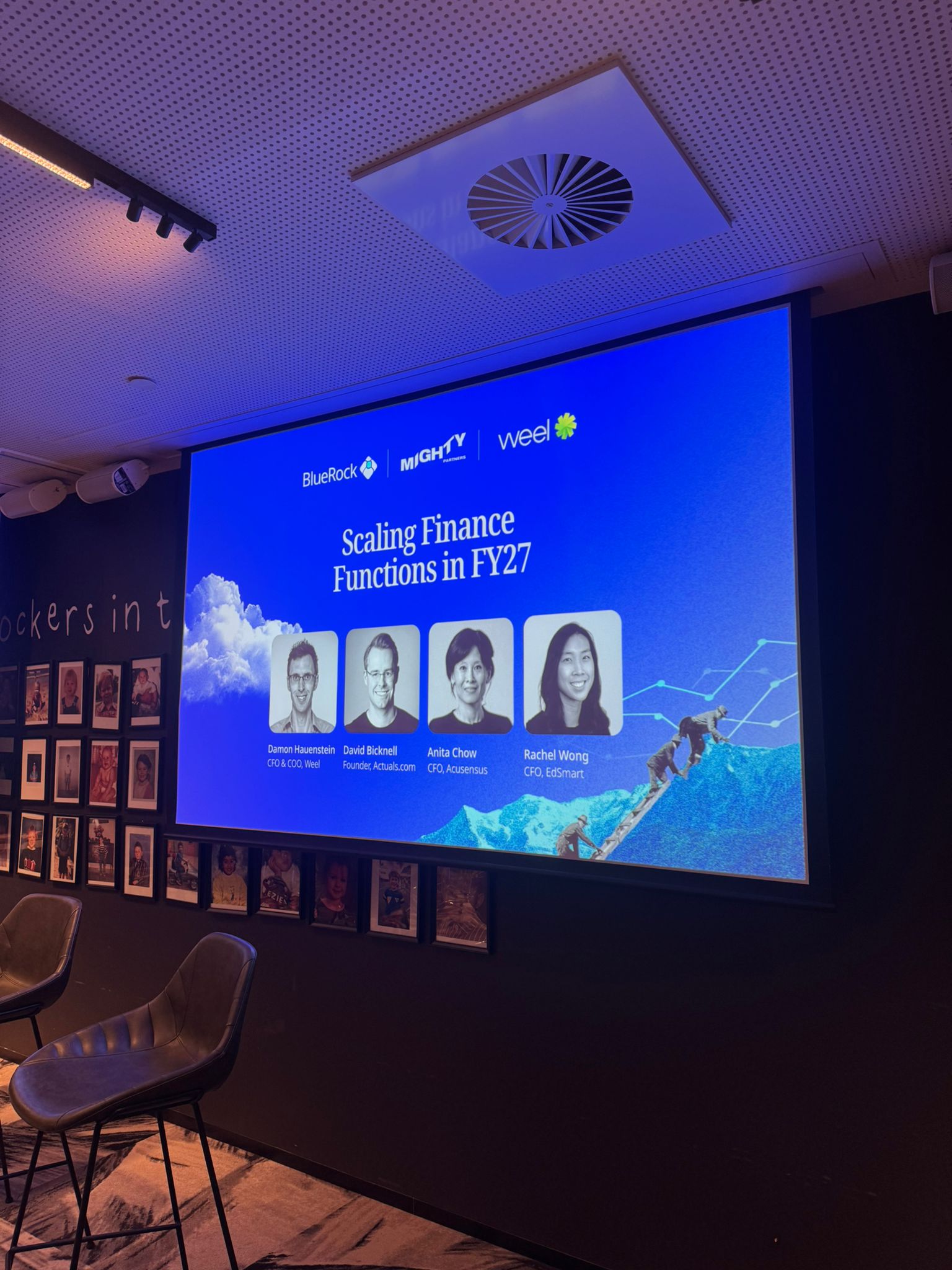
We partnered with Damon Hauenstein, CFO & COO of Weel, who sat down with three of Australia's leading tech CFOs; Rachel Wong (EdSmart), Anita Chow (Acusensus), and David Bicknell (Founder, Actuals) to get their honest take on where AI is actually landing, how finance teams are being rebuilt for FY27, and what the funding environment really looks like for scaling tech and software businesses.
The AI hype gap: what's real, what isn't
Ask any CFO whether they feel like they're keeping pace with AI and the answer, privately, is usually no. Rachel Wong was there six months ago.
"I was using AI every single day — Claude in Excel, Claude Code, the desktop app, all of it. And yet I kept seeing people on LinkedIn claiming they'd automated their entire job in two hours. Every day I thought: I'm using this a lot, why don't I feel as advanced as that?".
The answer, she found, was simpler than expected.
"The people posting constantly about AI automation are mostly people who monetise AI content. They want you to buy their course, DM them for a playbook, buy 500 prompts. The best thing you can do is just use it yourself, every single day, without comparing yourself to the noise. Compare yourself to where you were three months ago, six months ago. If you're optimising your workflows and being more efficient every week, you're probably ahead of most people."
David Bicknell, founder of billing and revenue accounting platform Actuals, points to something more structural behind the slow uptake in finance specifically.
"LLMs are built on next-word prediction. They're just not built for deterministic numerical work. You can still run a simple test today — try doing a timezone or FX conversion using any of the frontier models. They'll often get it wrong. A lot of early 'AI' finance tools were really just thin prompting layers on top of OCR."
But the picture is shifting. The more serious applications are starting to emerge — and they work differently to what came before.
"The key distinction is separating logic generation from execution: use probabilistic models to represent all forms of logic, then deterministic execution for repeatability — the same numbers in, the same numbers out. When you can crack that, you collapse everything down to a very simple level. It's going to be pretty profound for our industry."
Build vs. buy — and how to spot tools that are cosplaying as AI
For CFOs of scaling tech and software businesses, the build-versus-buy question is live right now. The right answer depends on where you sit.
Anita Chow, CFO of ASX-listed Acusensus, made the case for investing in core systems infrastructure first — before reaching for AI tools.
"We moved from Xero to NetSuite when I joined, almost three years ago. We were at around $40M revenue, and we've grown to close to $80M — heading for $100M next year. The system change automated lease accounting, fixed asset depreciation, inventory management. Month-end close that used to take 20 days is now manageable. We went from 100 to over 350 employees, and the finance function supported all of that growth with just one additional headcount."
Rachel Wong takes the opposite instinct — build first, buy later — and argues the hands-on process is inseparable from developing real judgement.
"I like to build things. My view is: once you hit capacity or something isn't scalable, you delegate and buy off the shelf. But the process of learning how to build something is part of learning AI. I tried to build a proper month-end app in Lovable first. The front end looked great; the back end couldn't handle the complexity. Then I tried Claude Code — functional on the back end, but ugly. After months of that, I realised I didn't need an app at all. A clean folder structure and workflow got the same result."
For tech CFOs evaluating vendor claims, David Bicknell offers a clear framework for cutting through the noise.
"If there's a lengthy paid integration cycle, that's not AI. If you're logging tickets to change the text in a collections email, that's not AI. If it requires heavy configuration and constant human-in-the-loop, that's not AI. When you build things yourself, you develop the taste to hold vendors accountable on all of those things."
His broader warning for CFOs evaluating their existing processes is pointed.
"Don't inject AI into each stage of your existing finance pipeline to make things slightly faster. If you do that, you compound whatever's already in there — bad data, bad processes, bad habits. AI is a compounding technology. The right approach is to go back to first principles: what are the objectives? Delete as much process as possible. Then replace with tools."
What finance teams actually look like going into FY27
Every CEO hiring a CFO right now says they want an "AI-enabled" candidate. The reality is more nuanced.
"That profile doesn't really exist yet. Don't select for it. Select for deep curiosity — people who are building things in their own time, developing intuition. Then start with one person. You genuinely don't know what the team shape should be until you've started."
Rachel Wong's test for AI-readiness is deliberately simple — and something any finance leader can implement immediately.
"For every single task in front of me, I ask: can AI help me with this? Big or small, same question. We just have this habit of going back to how things were done before — it feels faster. But you're not future-proofing, and you're not building the model's context over time. I also think of my Claude instances as team members. For month-end, I assign personas — the junior does the management accounting work, I review it, and before I deliver it I get the CEO persona to pressure-test it. You can challenge shaky assumptions without wasting anyone's real time."
Building AI fluency across a team with mixed experience levels is a different challenge. Anita Chow's approach is to lead visibly rather than mandate.
"When I figure something out, I share it. All I can do is encourage. With AI, you can't just teach it by telling people — each person needs to take the action themselves. What I'd say is: no one really knows. Everyone is learning as they go. The best thing is to help each other."
When debt makes sense for a scaling tech business
For founders and CFOs navigating growth funding, the debt-versus-equity question comes up early and often. The most consistent advice: start the conversation before you think you need to.
Anita Chow learned this firsthand at Acusensus.
"When I joined, we'd just IPO'd and raised $10M — it was supposed to last a few years. The business performed better than expected, and a year in I realised we needed capital much earlier than planned. Fortunately I'd started conversations with lenders six months before I thought I'd need them. Those early conversations meant we could move quickly when we needed to. We put in a debt facility and supplemented it with an additional equity raise. The key lesson: build lender and investor relationships before you need capital, not when you do."*
On the structural question of when debt is the right tool, her framing is practical.
"There's no one rule. It depends on the company, the shareholders, the cash flow profile, and the investment case. Debt makes more sense when you've got strong growth and a credible path to cash flow positive. Debt holders want interest and repayment; equity holders want performance and will hold you to your projections. Make sure whoever you're working with on either side is a genuine long-term partner."
The longer view on what all of this means for finance leaders who want to be in the top tier of companies coming out the other side belongs to David Bicknell.
"There will be a massive difference between the top quartile of companies and everyone else. That difference won't come from permission slips or safe experimentation at the margins. It'll come from teams that burn things down, rebuild, and push through to new levels of performance. Start early, be brave, and let the discomfort do its job."
Mighty Partners is a venture debt provider backing high-growth Australian technology and software businesses. If you're a CFO or founder thinking about non-dilutive capital options for your next growth phase, get in touch.


.webp)